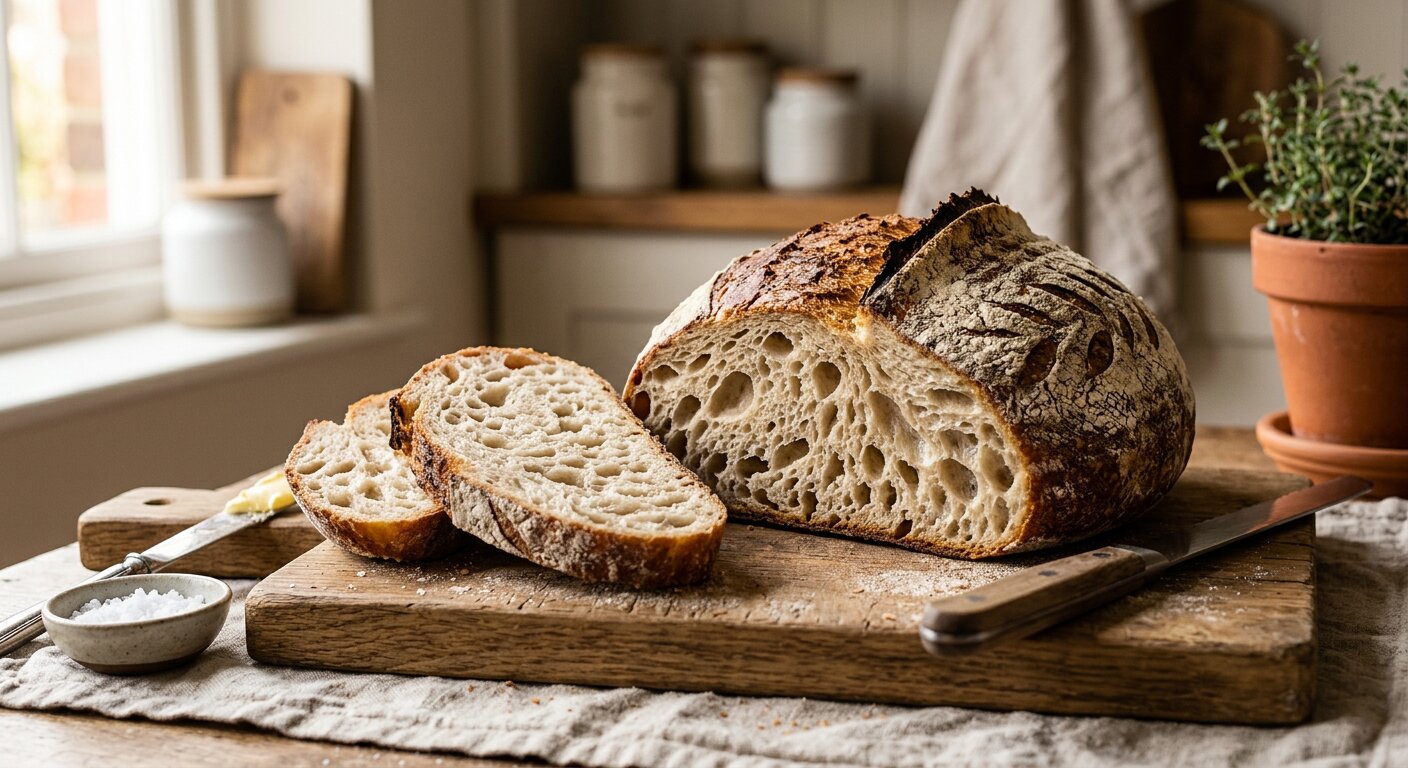
A tangy, crusty loaf with an open crumb — the recipe I've been perfecting for years.
| Prep | Cook | Rest/Proof | Total | Yield |
|---|---|---|---|---|
| 30 min | 45 min | 12–14 hr | ~15 hr | 1 loaf |
Difficulty: Medium
Levain
Dough
The night before baking, mix the starter, flours, and warm water in a small jar. Cover loosely and leave at room temperature (21–24 °C) for 8–12 hours. It's ready when domed, bubbly, and passes the float test.
In a large bowl, combine the bread flour, whole wheat flour, and 350 g of the water. Mix until no dry flour remains. Cover and rest for 45 minutes. Reserve the remaining 25 g of water for the next step.
Add the ripe levain and salt to the dough. Use the reserved 25 g of water to help incorporate. Pinch and fold the dough until everything is fully combined, about 3–4 minutes.
Over the next 4–5 hours at 24–26 °C, perform 4–6 sets of stretch-and-folds spaced 30 minutes apart during the first 2 hours. For each set, wet your hand, grab one side of the dough, stretch it up, and fold it over to the opposite side. Rotate the bowl 90° and repeat for all four sides. After the folds, leave the dough undisturbed. Bulk is done when the dough has increased 50–75% in volume, feels airy, and has a slightly domed surface.
Turn the dough out onto an unfloured work surface. Using a bench scraper and one hand, gently shape it into a round by tucking the dough under itself. Let it rest uncovered for 20–25 minutes.
Lightly flour the top of the dough and flip it. Pull the bottom edge up to the centre, then fold the left and right sides in. Finally, roll the dough towards you to create a taut boule. Place seam-side up in a banneton lined with a cloth and dusted generously with rice flour.
Cover the banneton with a plastic bag or damp towel and refrigerate for 12–14 hours. This slow, cold proof develops flavour and makes scoring easier.
Preheat your oven to 250 °C with a Dutch oven inside for at least 45 minutes. Turn the dough out onto a sheet of baking paper, score with a lame or razor blade, and carefully lower it into the hot Dutch oven. Cover with the lid and bake for 20 minutes. Remove the lid, reduce temperature to 230 °C, and bake for a further 22–25 minutes until deeply golden. Internal temperature should read at least 96 °C. Cool on a wire rack for at least 1 hour before slicing.